
Case study · Motion design
Space · Solar system exploration
Rosetta.
Excerpt · Letting go, 12 November 20141:18 of 9:00
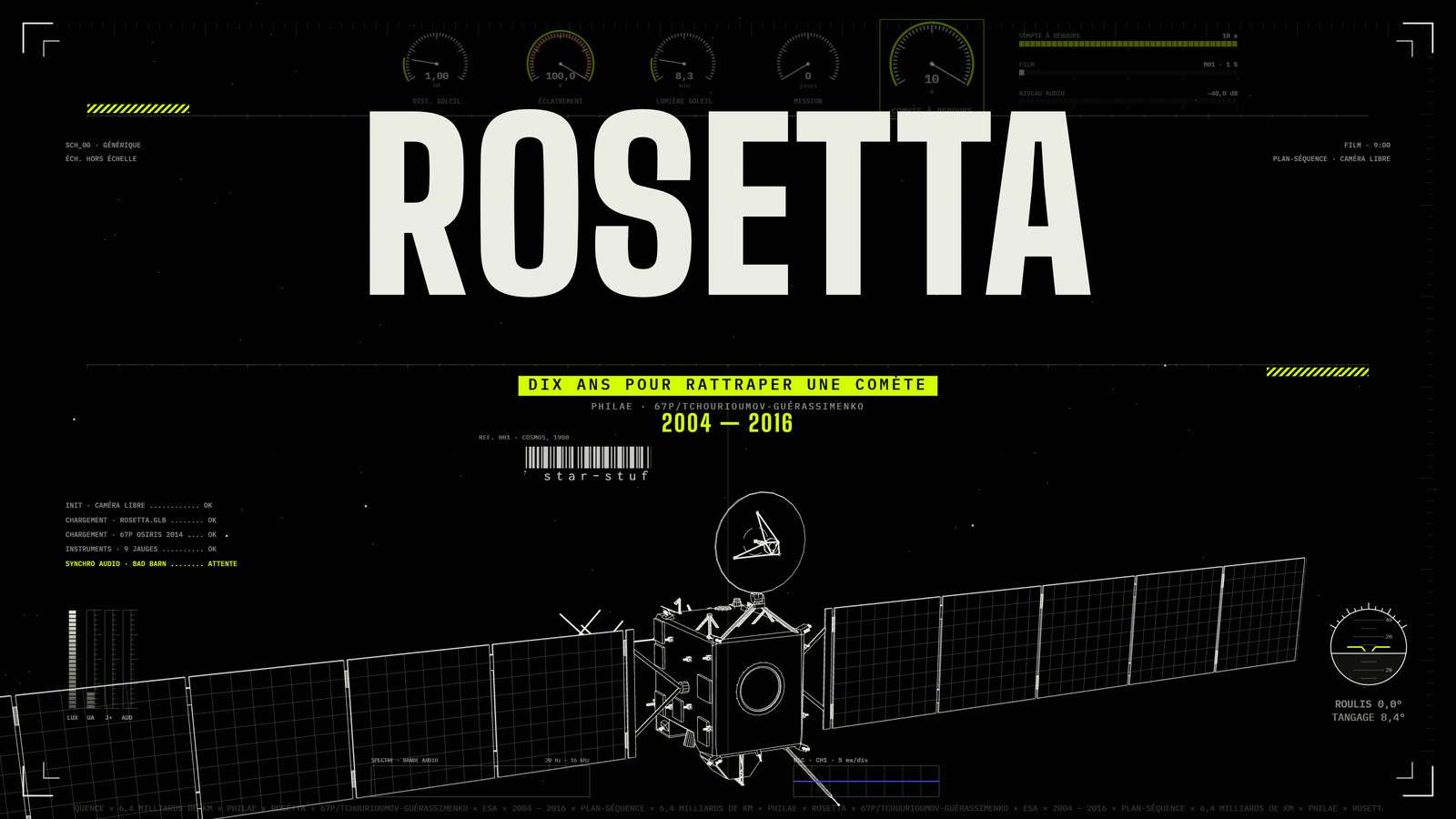
In 2004, the Rosetta probe left Kourou to catch up with a comet. Ten years later, it dropped Philae onto it: a small robot that bounced twice and came to rest in the shadows.
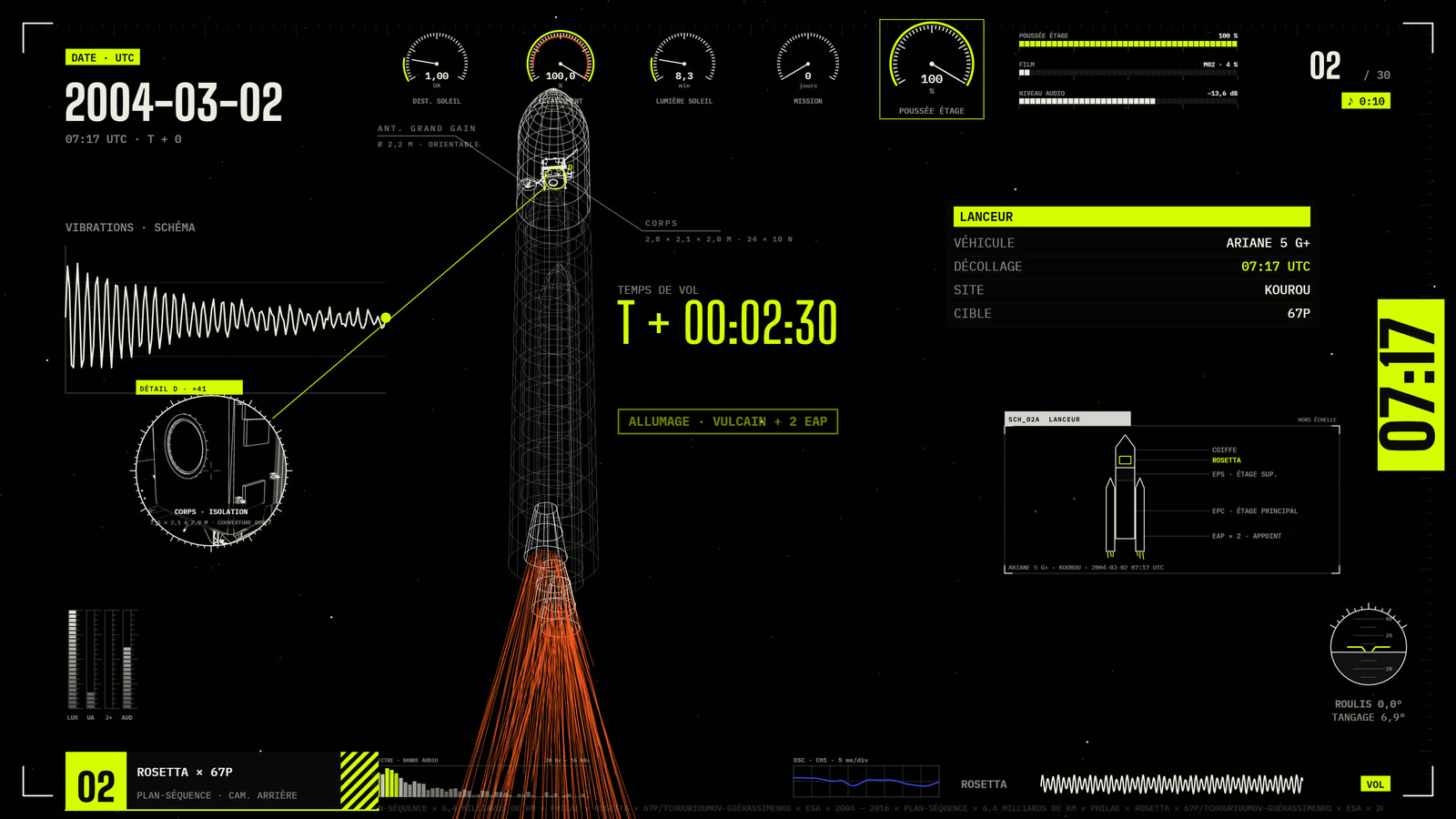
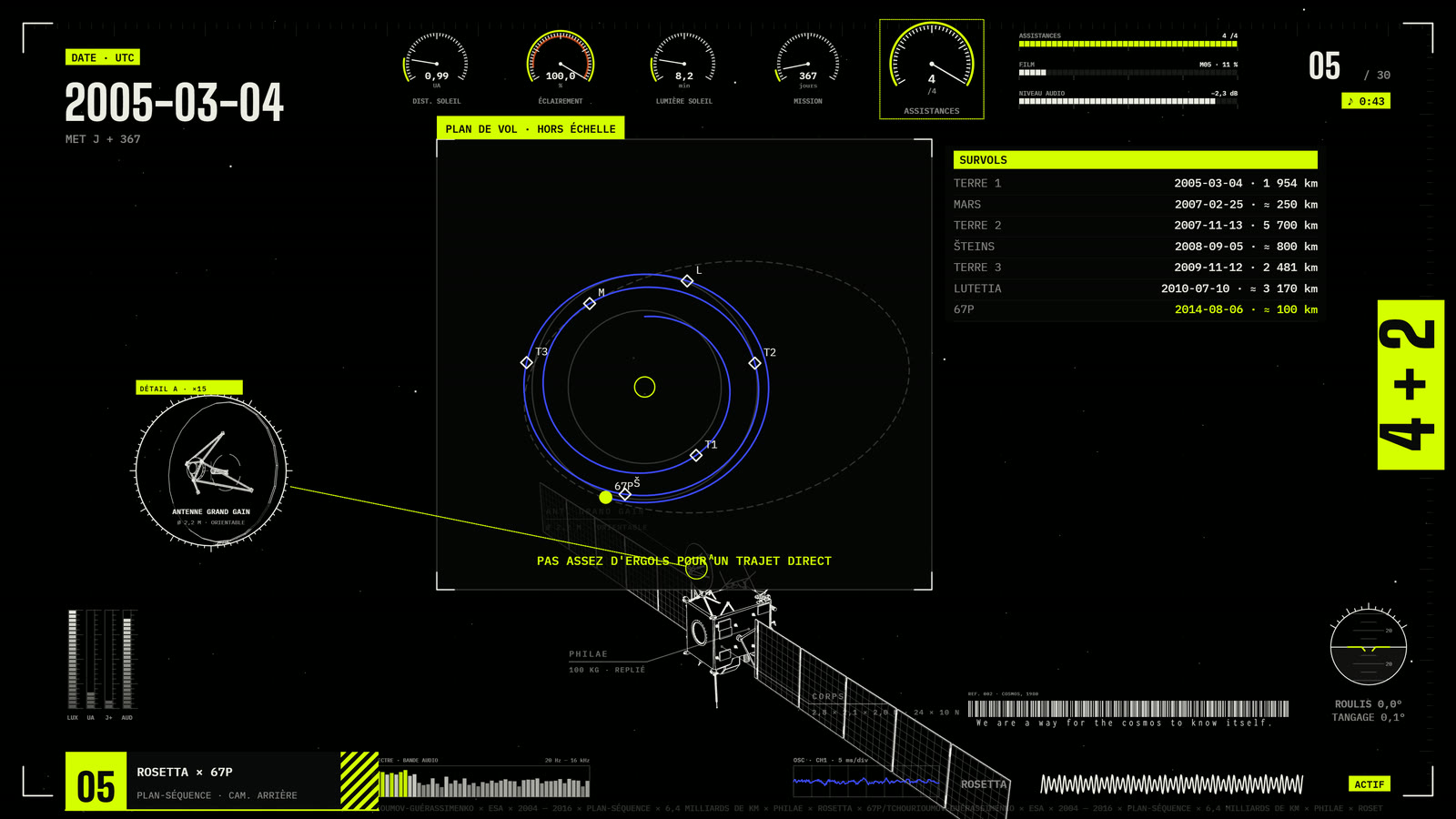
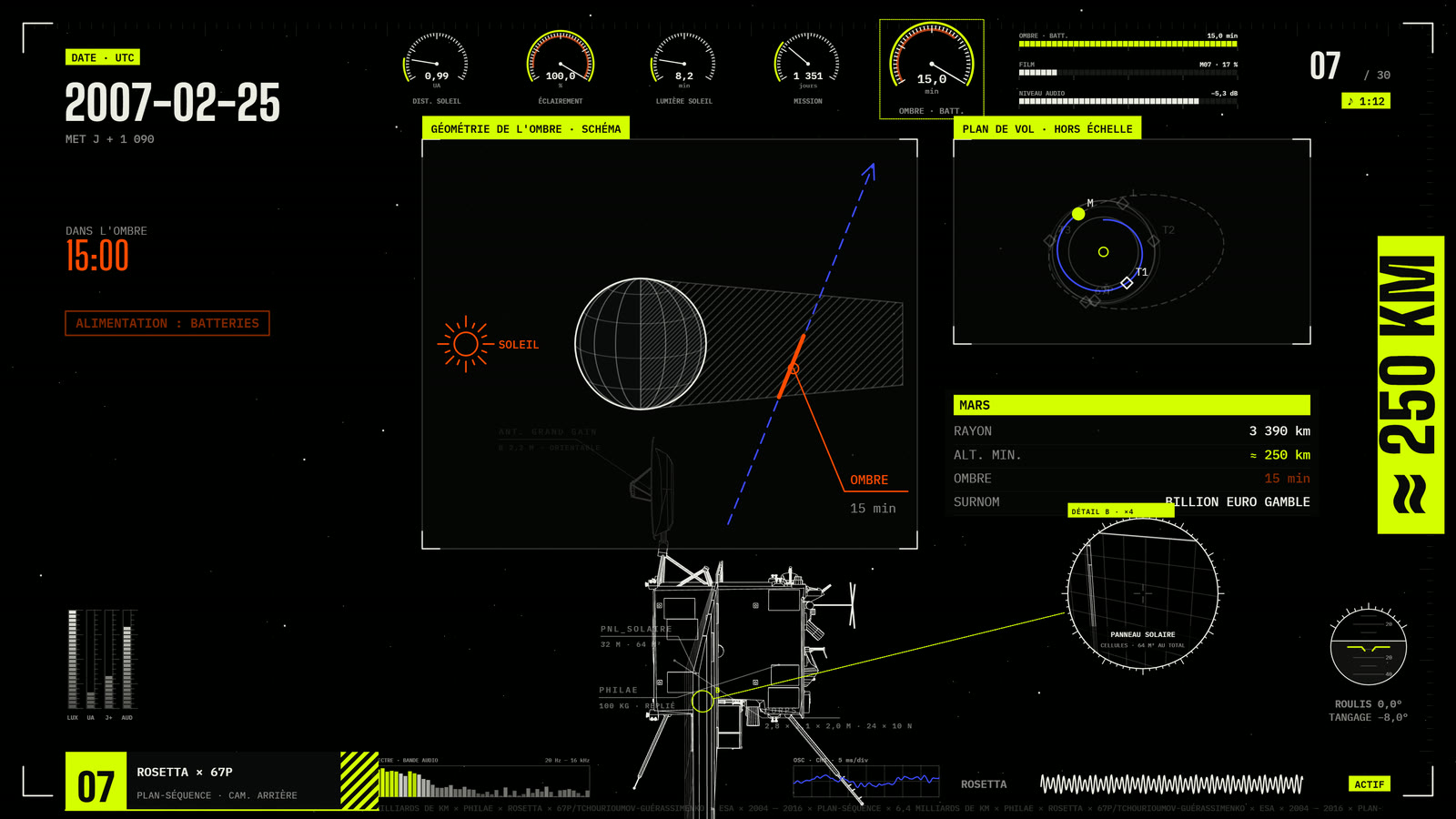
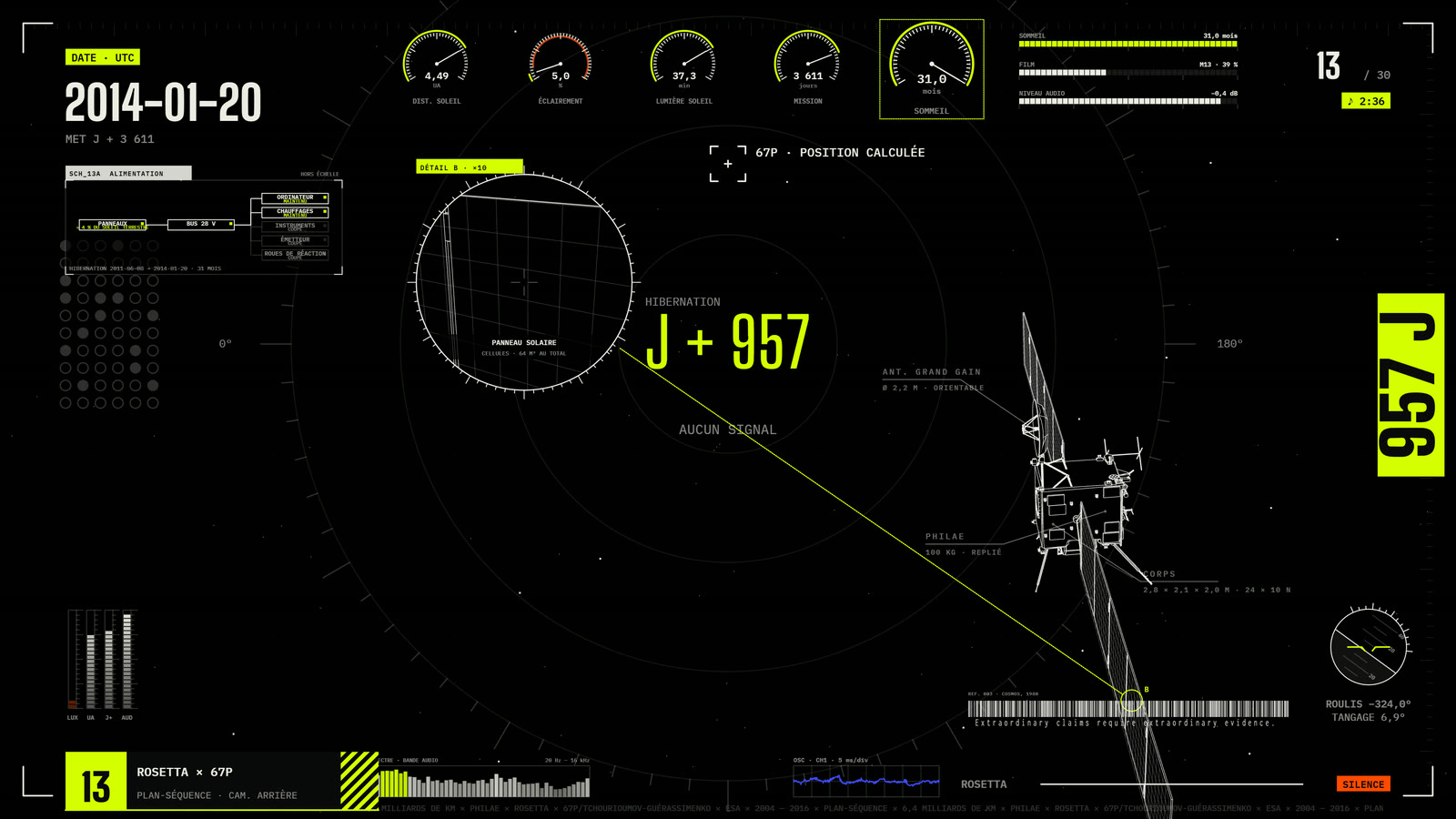
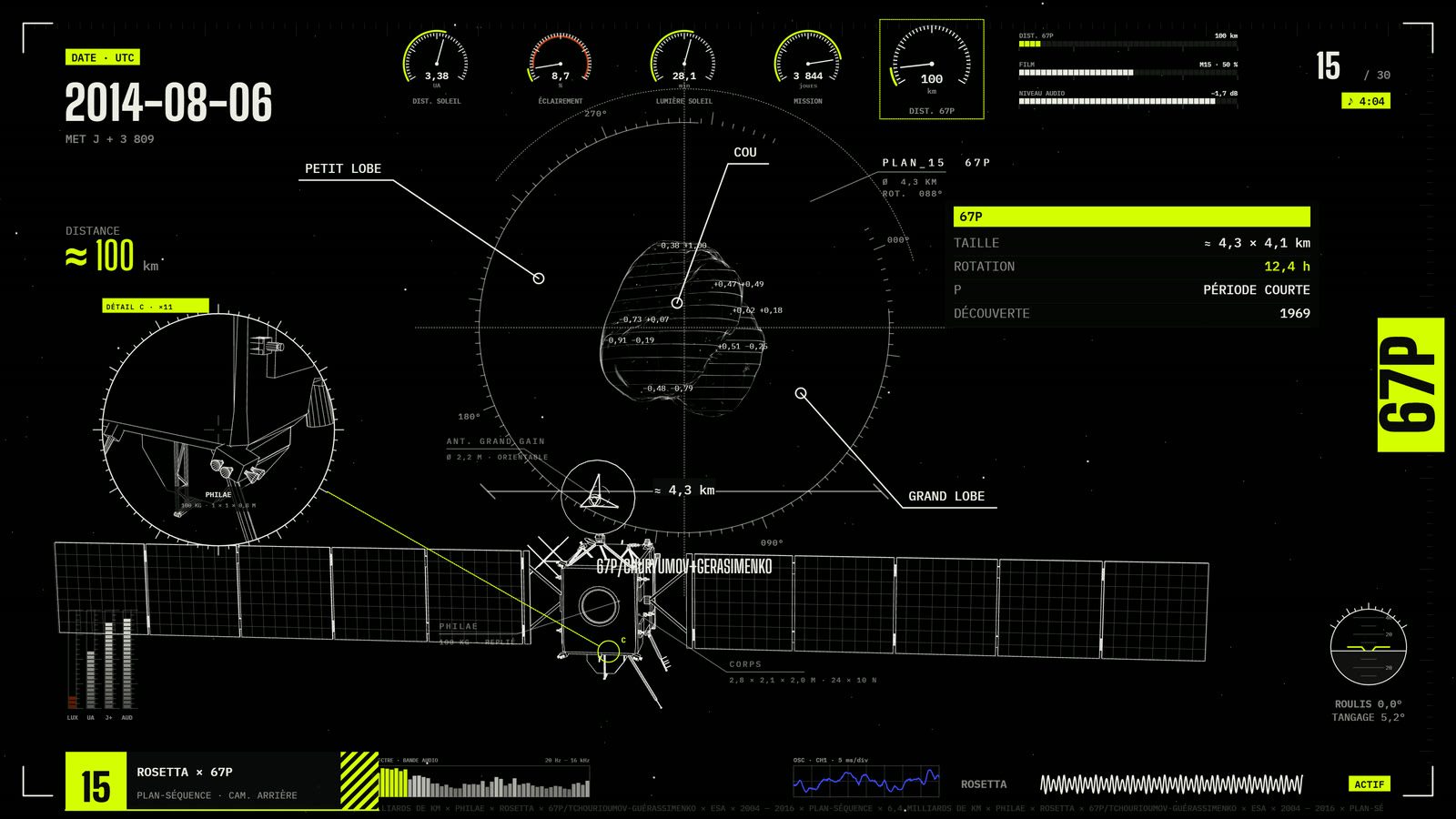
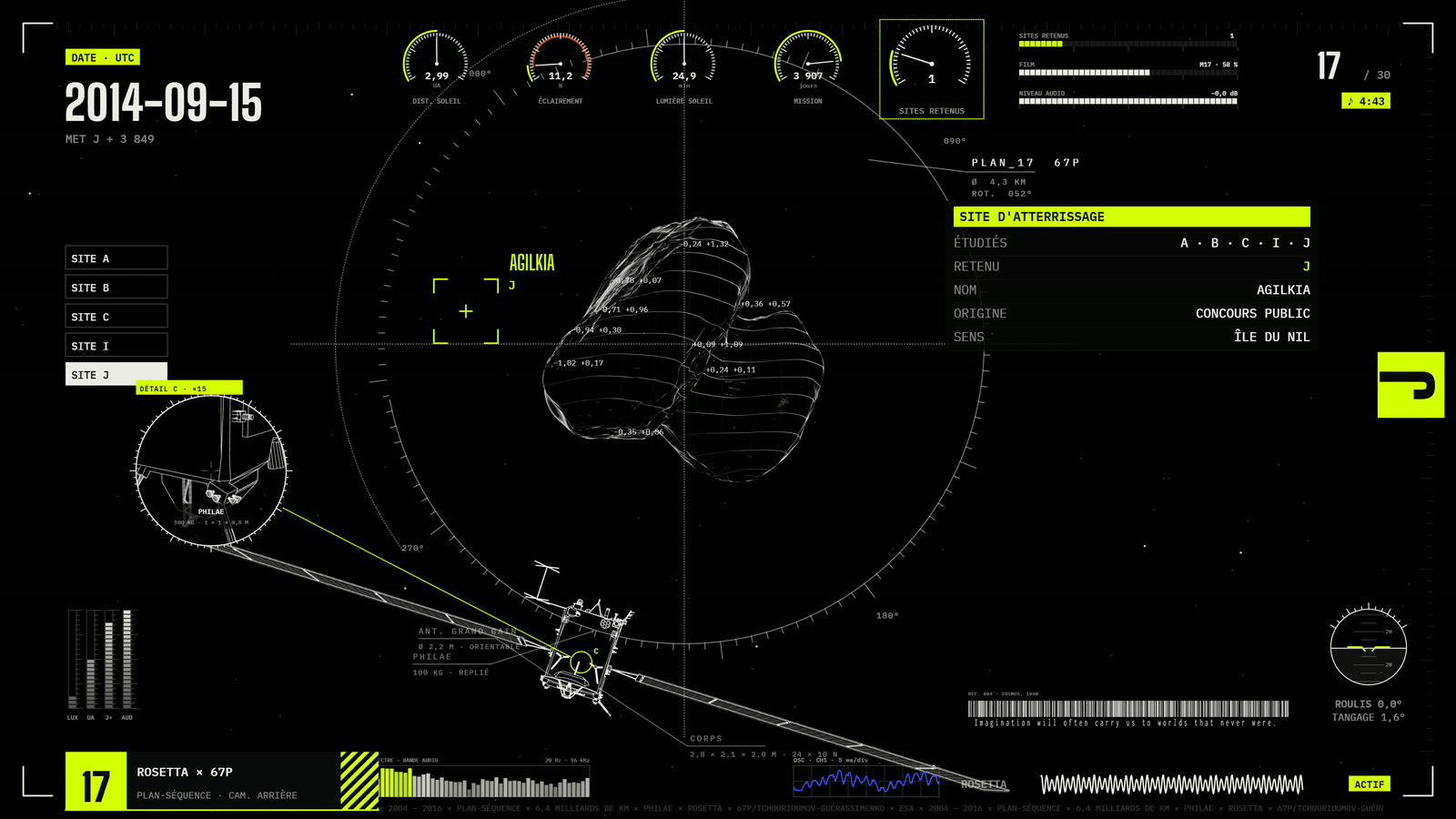
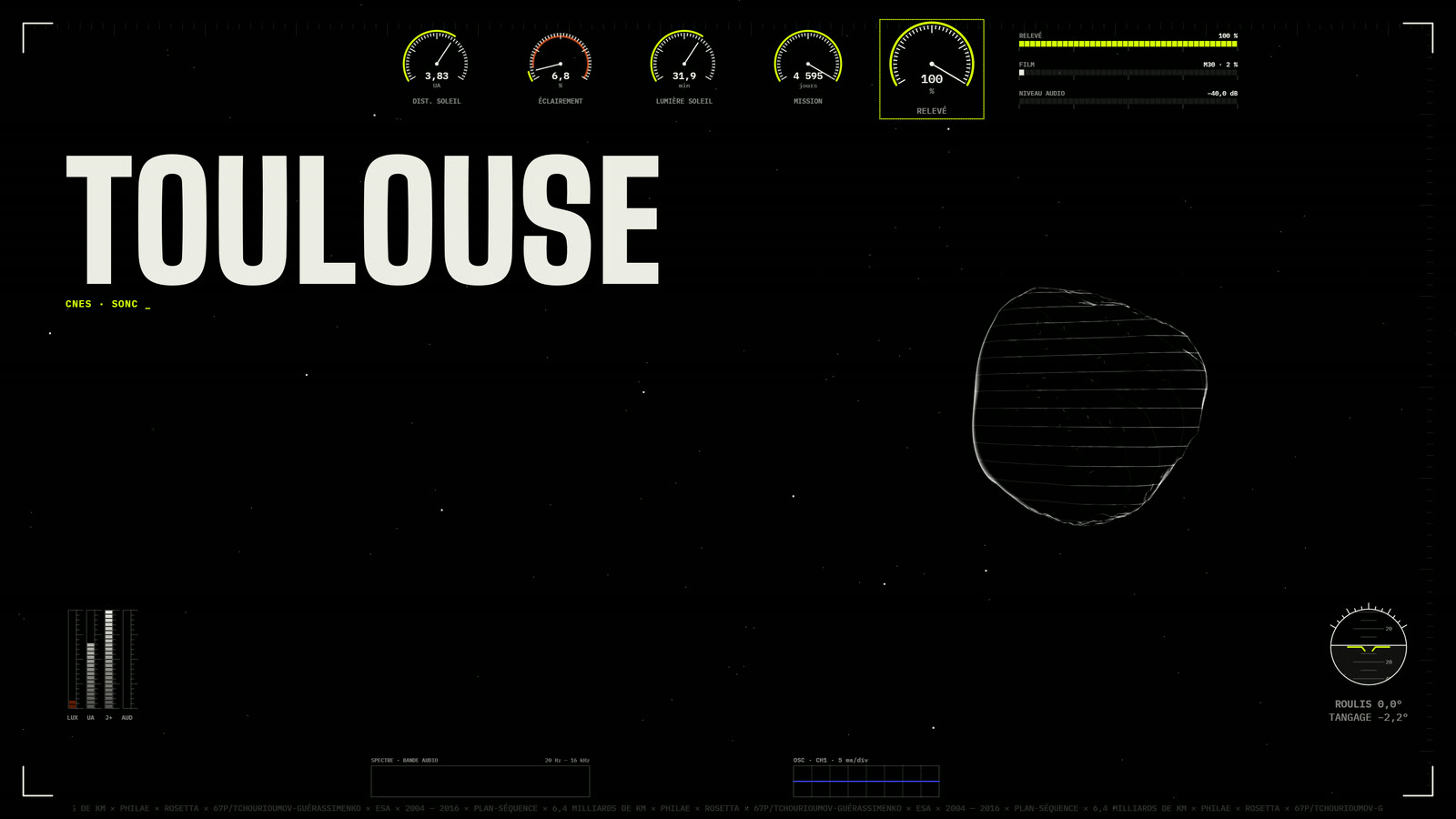
I told these twelve years of mission in a single shot. The camera stays locked behind the probe, and everything else, dates, trajectories, measurements, appears as on a mission control screen.
12 yrs
From Kourou to the comet
7 h
Of descent for Philae
31 mo
Of hibernation
60 h
Of work for Philae
01 — The approach
One camera, twelve years of travel.
No cuts, no change of viewpoint: the viewer travels with the probe. The scenery changes around it, Earth, Mars, the asteroids, the comet, while the frame stays put.
02 — The story
Eight acts, timed to the music.
Each step lands on a bar of the track. The information builds up during the first half of the step, then stays on screen long enough to be read.
- I
Launch
2004-03-02 · KOUROUFrom the closed fairing to the unfolded solar panels.
- II
Cosmic billiards
2005 — 2010Not enough fuel for a direct route: the probe gains speed by swinging past Earth and Mars.
- III
The long sleep
2011 — 2014Thirty-one months of hibernation, with no certainty it would wake up.
- IV
The comet
2014-08-06A duck-shaped body appears, and a landing site must be chosen.
- V
Letting go
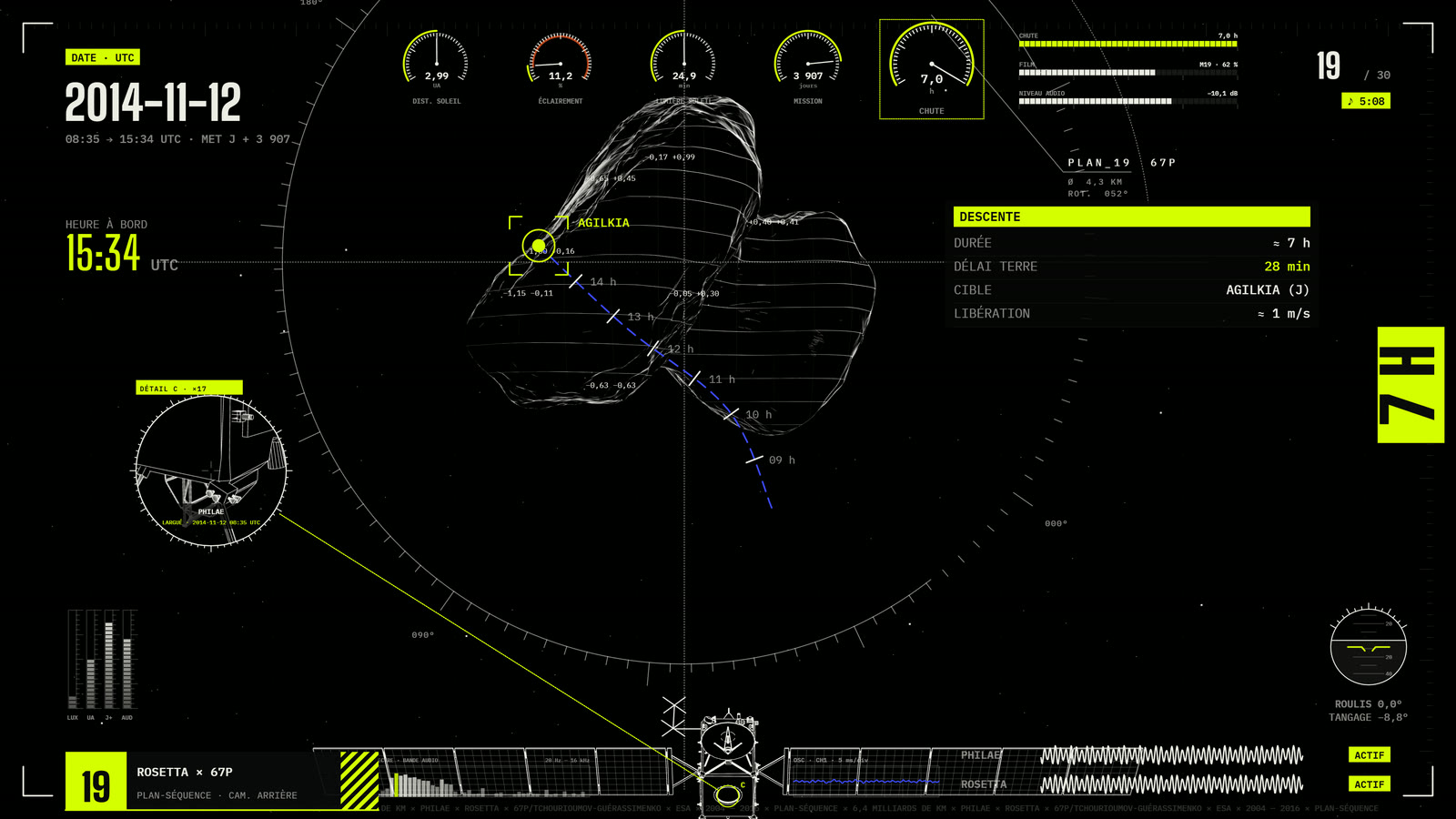
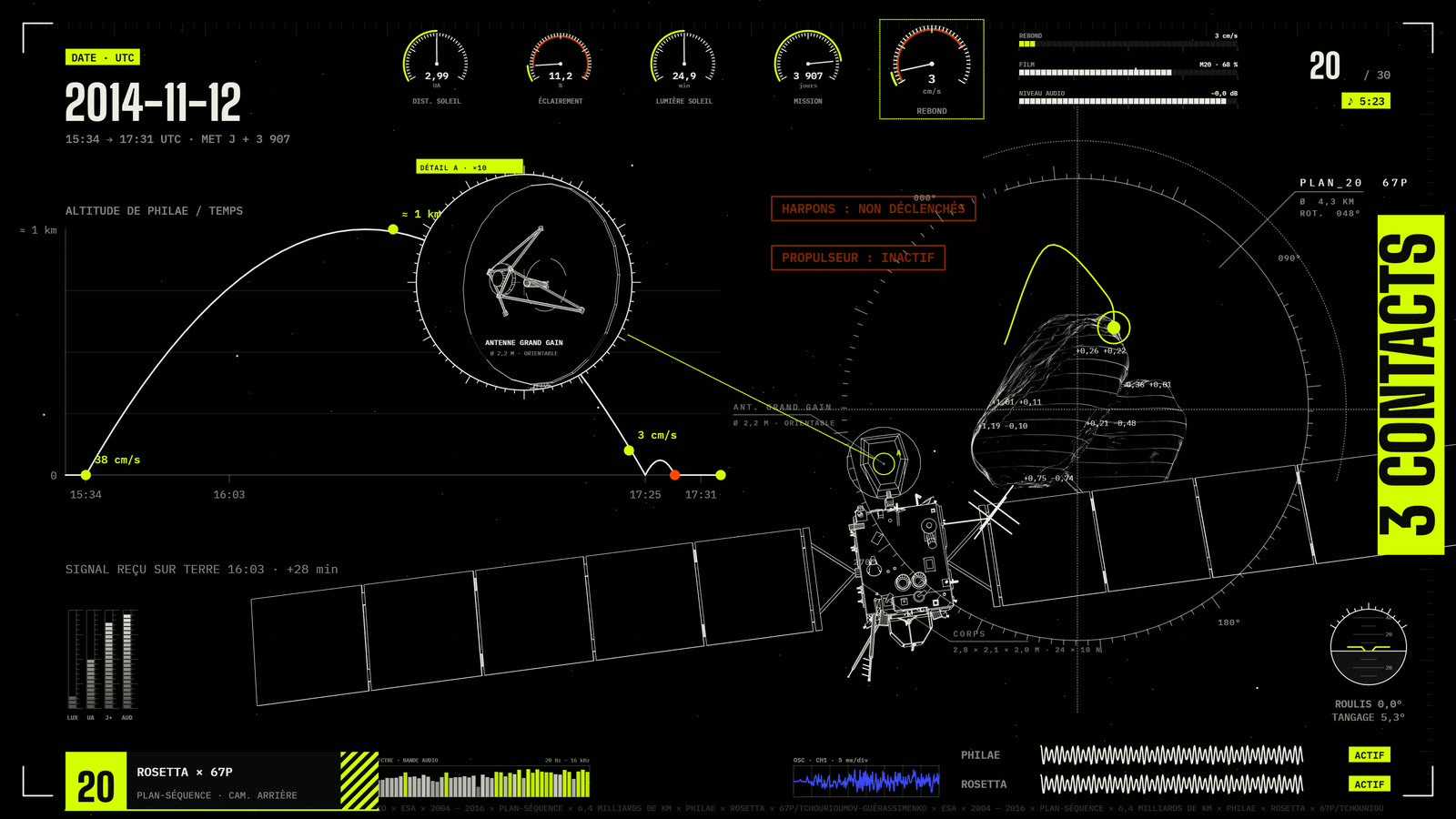
2014-11-12Seven hours of descent, harpoons that fail to fire, two bounces.
- VI
Sixty hours
2014-11-15Philae works on battery power, in the shade, then falls silent.
- VII
The comet’s summer
2015 — 201685 seconds of signal, then Philae is found in a photograph.
- VIII
The final descent
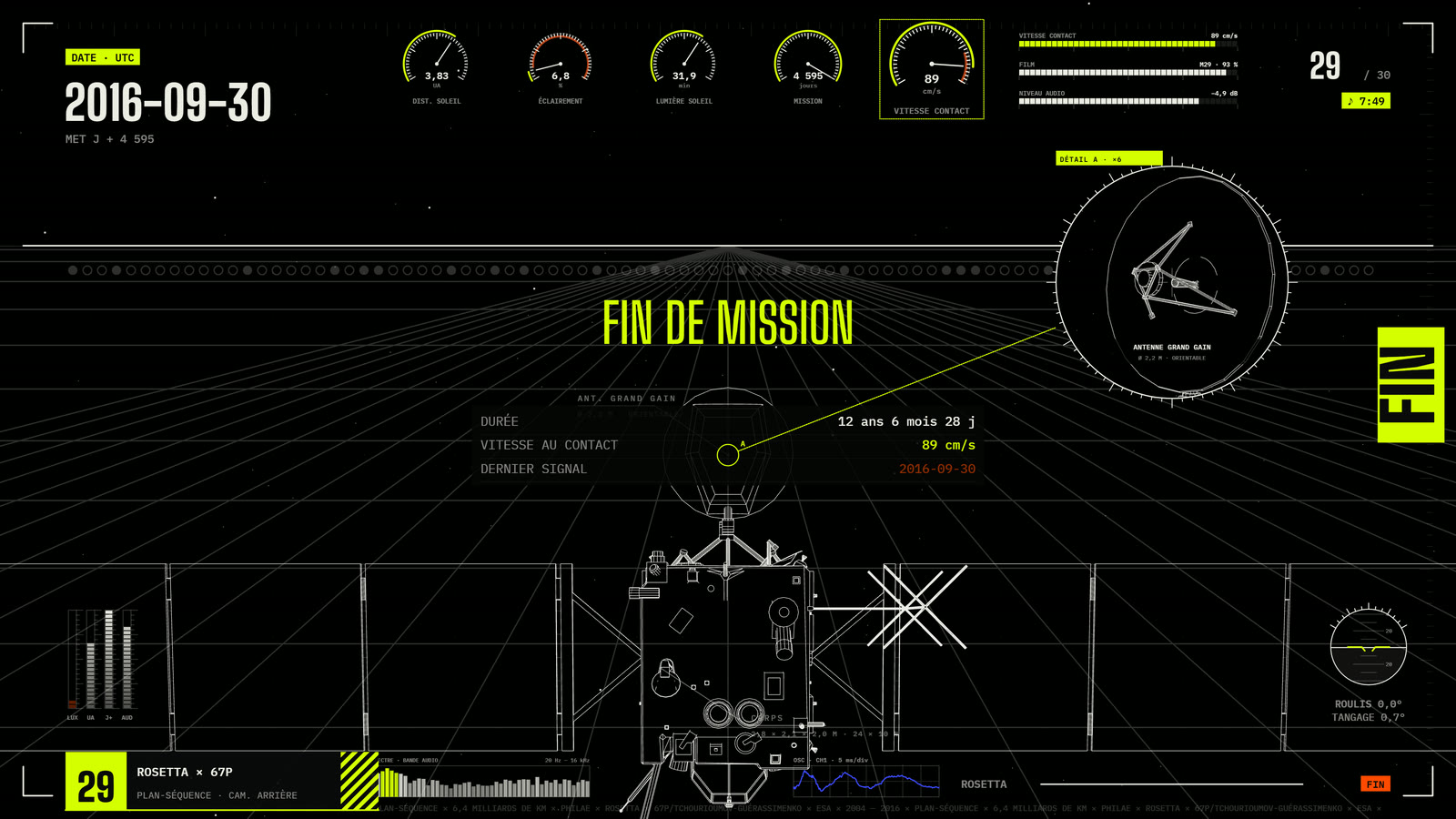
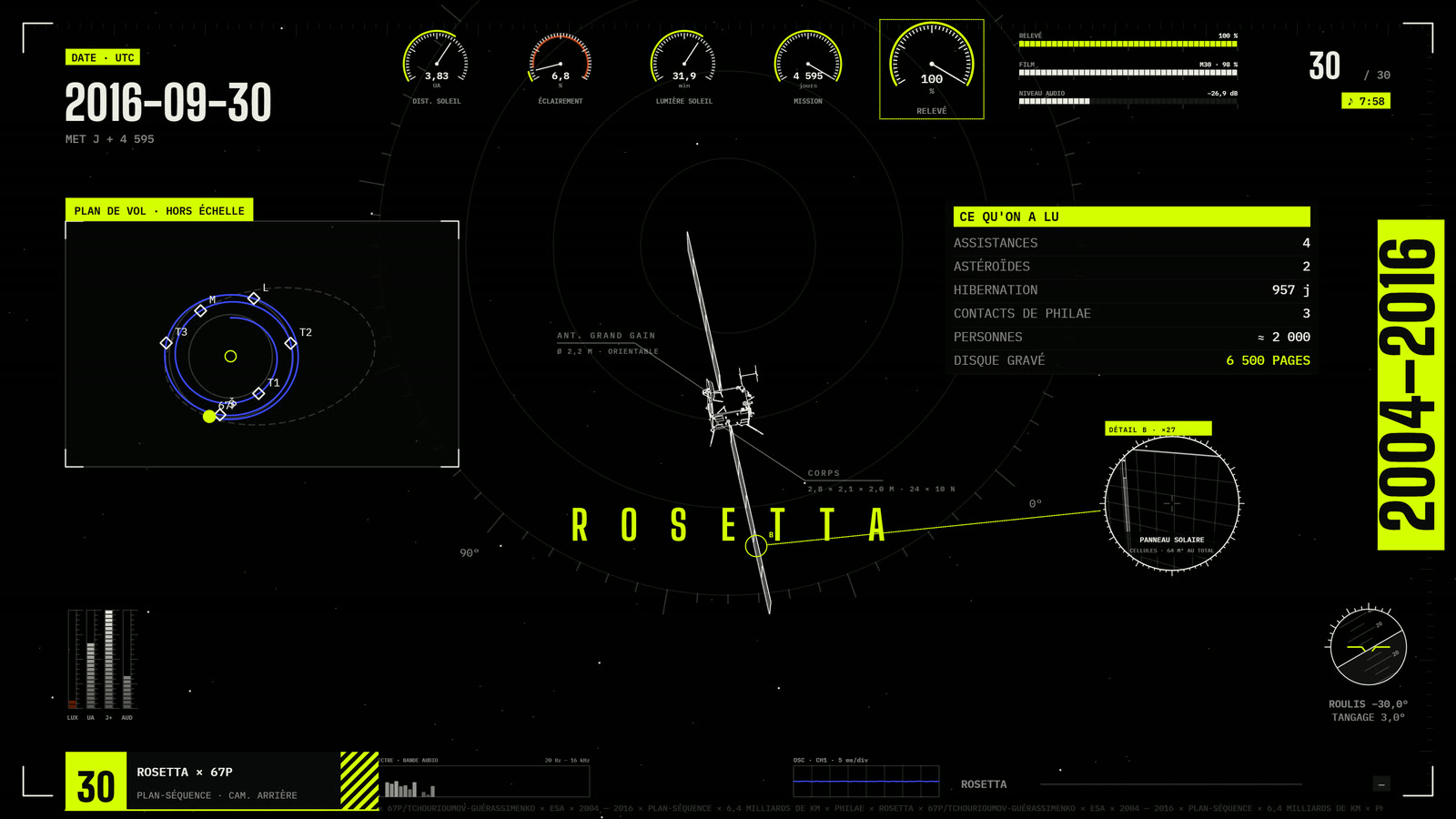
2016-09-30Rosetta joins Philae on the comet and ends its mission.
03 — The heart of the film
Seven hours of descent, three touchdowns.
Philae’s landing is the most anticipated moment. The real data, altitude, speed, contact times, becomes the staging.
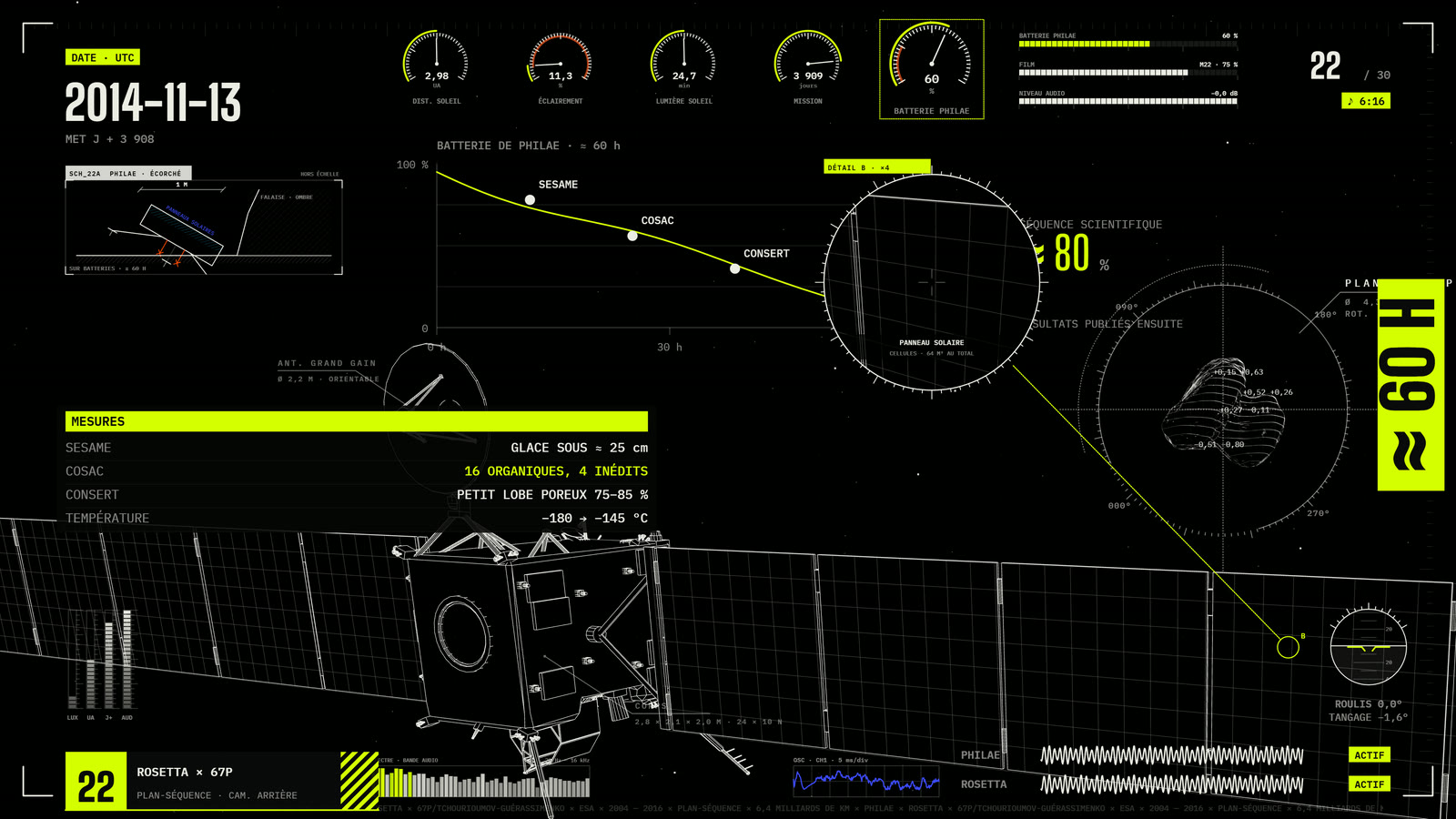
Ten years of travel, for sixty hours on a comet.
04 — The interface
A control screen, not an illustration.
The film borrows from mission interfaces and video game design: wireframes, inverted labels, hazard stripes, condensed type.
i.
All wireframe
The probe, the launcher and the comet are drawn as lines, like technical drawings. Nothing hides the information.
ii.
Checked data
Dates, distances, UTC times: every figure comes from ESA or CNES, and is shown in context.
iii.
A signal palette
Acid green for what matters, orange for alerts, blue for trajectories, on a deep black.
05 — Up close
Every line is there for a reason.
Rendered in 4K, the screen also reads up close. These close-ups are taken at the image’s native size: dials, diagrams, magnifiers and curves, as they animate in the film.
06 — How it was made
A film written in code.
The film is a web page: a 3D scene and an interface drawn frame by frame, both driven by the same timeline.
The research
Facts gathered from ESA and CNES, then broken down into scenes.
The storyboard
Thirty moments described, with their data, diagrams and animations.
The prototype
Three.js for the 3D, a canvas for the interface, and the music analysed to time each step.
The render
The film computed frame by frame in 4K at 60 fps, plus a vector export for After Effects.
Sources
Where the figures come from.
Dates, distances and times are taken from ESA and CNES publications, cross-checked with Wikipedia.
European Space Agency
CNES (in French)
Encyclopedia
3D models
- Rosetta probe · NASA 3D Resources
- Comet 67P · ESA/Rosetta/MPS for OSIRIS Team MPS/UPD/LAM/IAA/SSO/INTA/UPM/DASP/IDA
- Earth · NASA Blue Marble
- Mars, asteroids · NASA 3D Resources
This film is not produced or endorsed by ESA, CNES or NASA.
Music
“Bad barn” by Bitbasic, from the rec72 Netlabel 5th Anniversary compilation, via Free Music Archive. Licensed under Creative Commons BY-SA 3.0.